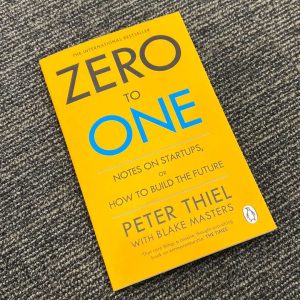
1. Zero to One and the Myth of Competition
You want a monopoly which is typically generated from: propriety technology, network effects, economies of scale, branding. Start small then monopolise the scale up. The example is given of how companies that say they are unique but aren’t try to convince their markets of their individuality. While companies with actual novelty or key innovations do their best to persuade regulators that they’re not so different or aren’t monopolistic in their chosen markets to avoid penalties. Peter Thiel advises strongly against getting into established markets without an offer that isn’t at least 10x better than what already exists.
2. Last Mover Advantage
A key opportunity is to be last, but best, or at least effectively different in a given market. A just stated, the new solution has to bring a 10x benefit to what is currently offered, as if not, the market won’t be motivated to change or adopt it. But when the market is primed, operating with high volume and high margins for a current offering. In a given market cycle this is a great opportunity to see what others companies done before, then triumph with a superior solution that enjoys wide market adoption and significant sales as a result.
3. The Power Law
It has to be added that normal distribution isn’t equal distribution as almost always there is a large player with other smaller players that, when even combined, don’t come close to rivalling the single market leader. This is what Pareto found all those years ago and is ratio is seen across nature from bacteria to galaxies and throughout business – it needs to be respected.
The power law is my favourite concept from the book as it brings attention to how the world of business actually works. Based on the Pareto principle, the power law draws attention to the fact that a small number of anything dominates the rest: 20% of pea plants produce 80% of the peas, a small number of earthquakes dominate all the rest in magnitude and a small number of cities dwarf the majority of all cities. The same principle applies to business as, through monopoly, a small number of businesses in a sector have all the rest in their shadow – and these monopolies are the ones you want to look for and even start yourself. The book moves from business to capital ventures to provide the experiences of how a single investment or portfolio item dwarfs all others. Admittedly, it’s hard to judge ahead of time what these rocket ships of value will be; however, by applying the power law and auditing investment opportunities with the key questions below, you can improve your analysis to increase the probabilities of benefiting from your investments.
4. The Key Questions
Engineering – is your technology a breakthrough or is it only incrementally better?
Is your company offering a game-changing, unmatched, world-beating or secret product or service that is new and better by several magnitudes than anything else on the market? If not, then you’ve not answered the question correctly.
Timing – is it the right time for your particular business?
The wrong time for a game-changing business with a novel or superior solution can result in the same outcome as a bad business. As if the market isn’t ready or the opportunity of need or want isn’t there, then failure is likely.
Monopoly – are you starting with a big share of a small market?
Is the market suitably addressable? Is there sufficient meat on the bone to deserve the required attention to even justify establishing an innovative business in the first place? If this isn’t the case, then perhaps it should give cause for concern and a reason to pause or stop until conditions change.
People – do you have the right team?
Your team has to be innovative and specific in their skills and passion for success and in their core competencies of the company product or service. They have to be able to justify why they want to work in a zero to one company instead of an established organisation – it’s a key requirement before they can be permitted to join the team.
Distribution – do you have a way to deliver your product or service?
Monopoly product or service check, great team check and the market is salivating for your solution check – but can you distribute it and serve potential customers? This is a serious question to be evaluated during the planning process and a decision made accordingly.
Durability – will your market position be defensible 10 and 20 years into the future?
Ask if your product or service has the legs for longevity so it can serve its markets now and dominate the sector for years to come so as to deliver regular profits to shareholders. Innovation that is short-lived or a one-and-done is of no interest to investors and won’t be a monopoly for long.
Secret – have you identified a unique opportunity that others don’t see?
What do you offer that is the best, the most innovative, serves the market without equal? This is likely going to be the secret sauce or patentable property that is the flux capacitor that makes your company different and thus better than all others, and for some time to come in the future. When you have this, you have to protect it, market it and sell it widely to generate a successful business – going zero to one.
The example company that satisfied all these key questions was Tesla, as it is undoubtedly successful via innovative means. Attention was given to how Tesla answered the timing question. As it was timely in benefiting from environmental concerns and winning government funding to establish key infrastructure, reducing development time and advancing their technology while accelerating beyond any competition.
5. The Founder is also One to Zero
Founders can also be unique or one of a kind to create and drive a zero to one organisation. They can be on either side of the spectrum of nerdy or charismatic; all they can’t be is in the middle of the bell curve— as they would have competition which is to be avoided. The examples of such founders are: Steve Jobs, Bill Gates, and Elon Musk.
I’m ending this article with how the book starts as Peter Thiel opens the first chapter by sharing an interview question he asks candidates, which is “What important truth do very few people agree with you on?” This question forces people to think about what they specifically consider valuable, what is not openly discussed, but when realised there could be agreement. This is asked to make interview candidates think in a zero to one mode – as I hope this article has inspired you to do also.