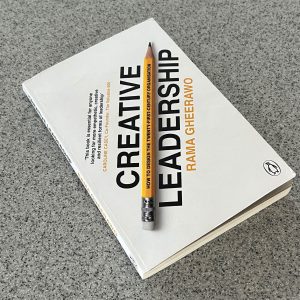
Relaying my key takeaways from the book “Creative Leadership” by Rama Gheerawo. I read the book as I am keen to bolster my leadership qualities as a right brain thinker involved in the creative and wellness sectors. Reading this book was meant to add a creative layer or focus to my already significant leadership and management knowledge (shout out to Manager Tools podcast).
In my personal experience I rarely use my leadership knowledge and I have rarely, if ever, been managed by a manager who truly understood creativity and the kind of business power it can deploy. My leadership and management knowledge centres, rarely if at all, got exercised outside of managerial instruction or the creative brief. I distinctly remember in the book “Beermat Entrepreneur” that they strongly recommend only letting your tech talk to their tech in meetings, and if they didn’t bring a technical person then yours should be kept a hundred miles away from any sales meeting. And creative people could be seen or regarded as even worse than technical staff.
So my reasons for reading the book were strong as I was hopeful in learning how to be part of teams better and understand how to lead teams of any kind better using my creative attributes.
Current Leadership
Personally the MBA has a lot to answer for as I often feel those with one seem entitled on a do not stop till reaching the C-suite mentality and on they way the very salient points of the book are bulldozed out of sight. In fact anyone watching the BBC Apprentice will know this to be the case, and those who saw the USA Apprentice and who was leading that for a while certainly knows. Johnny Ive has long faded from the Apple spotlight where he could be said to embody and bring design values to highest level of corporate and consumer attention – but that was ages ago now and I have no idea who leads the design at Apple now.
The short book is built around inclusiveness within leadership and how this can benefit an organisation which was split into: creative leadership, empathy, creativity, clarity and achieving balance, which is then all brought together in a final leader. Rama does exude leftist thinking and tendencies as the book is advocating for a break from the norm of capitalist dogma and profiteering greed to more humanistically innate values that better the person and society at a transformational and holistic level.
His focus is clearly on “human value, not fiscal return” but as business leaders unwittingly know this altruism is actually rather profitable. Rama isn’t share holder centric, he’s people-centred, wanting to make a positive difference in areas that would most benefit from design, but don’t have that immediately return on investment. The book highlights how in the USA only 4% of the population is 6ft 2″ tall but 30% of a CEO sample were 6ft 2” tall and most were male; the same could be found in politics.
New Leadership
A key concept of the book is bringing your head, heart and hands together to create an atmosphere of love and service by moving from a culture of ME to WE. It’s suggested that organisations move from hierarchical structures to be more intellectual and functional. There is a balance to be struck and Rama indicates that classic management needs to embrace empathy, while stating creatives should avoid withdrawing, to perform openly and should adapt to working more on-the-fly.
Key performance indicators should be balanced with: pioneering thought in action, volatility, uncertainty, complexity and ambiguity. And these need to be navigated and mapped around empathy, clarity and creativity. Being “change ready” is seen as a bridge between the two worlds with adaptability well understood by classical management.
Empathy
I want to relay the three key aspects by Rama: the first is Empathy, the one I consider essential to being a designer and which demands that you put yourself in the shoes of the people your trying to help or inside the problem you’re working to solve. This “method designing” as like “method acting” is invaluable research and any solution is nothing more than abstract without it. Being empathic is a lived form of research and one that is superb at creating creative opportunities which are highly relevant.
In the book the example is given of how his team was tasked by a mobile phone manufacturer to look at how old people could engage with a new touch screen model that was being released. The executives wanted his design team to focus on the screen design, but Rama directed attention to what they had found during real world research and that was – set-up issues. The executives didn’t understand, so Rama asked them to go out, buy a related phone, set it up and make a call – they all struggled as the process was poor, cumbersome and something they never had to do. This real world process instilled the experience of their users and created empathy through a shared experience of frustration.
The use of empathy directly applies to leadership in addition to creativity by encouraging or enabling people to really hear, feel and relate to what people have to say. This will allow better leadership from less friction in the communication and the implementation of the resulting decisions and actions. At the same time it is stated that you don’t lose your personality or individuality as a person or a leader; instead empathy empowers your ability to be harmonious across: listening, doing, thinking, acting, reflecting and actioning. The managerial sense of self should be so strong, that it can be so open, that it can welcome and embrace everyone’s contribution.
“empathy allows you to actually see”
Creativity
Leadership gives permission to themselves and others to be creative, discover and seek magic to open up possibilities. They should also remove the stifling factors to creativity: stress, lack of time, constraints, fear of failure, lack of imagination, lack of movement and being judged. This environment would then encourage the higher functions: spontaneous insights, future-based thinking, planning, decision making, improvisation and the ability to hold multiple tracks of complex information in your mind at the same time.
Organisations really benefit from creative people being able to operate freely individually or inside a team when innovation in the marketplace is key.
The author relays the power of his workshops which aim to release the creative potential from those who don’t consider themselves creative but are, and can effectively contribute to their organisations, but this blog isn’t about unleashing creative potential, but a good leader and manager should be creating the environment within which ideas and concepts can arise, be heard and recognised for the value they bring.
“feeling like you can solve anything’
Clarity
When operating in ambiguous environments clarity becomes a key attribute to successful leadership as “reality eats strategy for breakfast”. A creative leader needs all kinds of clarity to bring a project to a successful completion: clarity to understand the problem, clarity of clients needs, clarity of vision, clarity of concept, emotional clarity and cognitive clarity. Self honesty lies at the heart of the creative leader and across the members of their team. Clarity cuts through stereotypes, assumptions, the easy solutions to see the people, the problems and the opportunities directly so as to effectively understand and address what is required – clarity is an enlightening force in separating personal truth from universal truth. Creative leadership isn’t defined by the ability to control, but by the ability to respond and accept.
‘if empathy is the heart, and creativity is the hand, then clarity is the head’
Creative Leadership
Leadership is about uniting people around a common purpose and creative leadership brings a multi-handed and multi-perspective approach that’s: playful, conversational and human. The author states that a single individual can be a powerful source of insight. Here he recalls seeing many a colleague shouted down by an authoritative figure for suggesting ideas for well meaning change – and I wonder how many of us have witnessed this ourselves in meetings. So leadership should support creative talent and the exploration of their mental models to inspire and bring change – as you never know how far a change will go.
“a transformational process based on empathy, clarity, and creativity that can be applied to individuals, groups, organisations, technologies and projects.”
Conclusion
Changing the stifling model of leadership, and removing the limitations of hierarchical models, is a key concept of the book. Then the creative factors and opportunities of how leadership can be better are anchored across: empathy, creativity and clarity. Leadership can often be process based and this is stated as a limiting factor within an organisation.
Fundamentally creativity and leadership could be said to be incompatible, as often creatives do things differently, walk their own path, and always standing out; but as the book makes clear these people and their processes are to be trusted and valued for the contributions they bring.
Should you have a project that needs managing creatively then get in touch with me.